

Architecture
ConfigDirector Architecture
This section explains the high level architecture on how ConfigDirector evaluates config values and how it delivers updates to client and server SDKs.
For both, client and server SDKs, there are two connection mode options: streaming and polling.
The streaming connection is the default behavior. In this connection mode, the client or server SDK opens a persistent HTTP connection to the ConfigDirector services. Upon connecting, it receives an initial payload with all the config values. From that point on, the server pushes any updates via Server Sent Events (SSE) whenever configs are updated. If the connection is dropped, the SDKs will automatically attempt to reconnect after 2 seconds, and apply an exponential backoff if failures continue.
In the case of the polling connection mode, the SDKs retrieve all the config values with an initial request. From that point on, they periodically poll the ConfigDirector services for additional updates. The polling interval is configurable, and every SDK enforces the same minimum, described in Polling intervals below. The use of polling is discouraged and should only be used in circumstances where a persistent streaming connection does not work within your system's constraints.
Polling intervals
Every SDK of the same kind shares one default polling interval and one minimum polling interval:
| Kind of SDK | Default polling interval | Minimum polling interval |
|---|---|---|
| Client SDKs (JavaScript, React, Vue, Next.js client side, Nuxt client side, React Native, Flutter, Swift, Android, and their OpenFeature providers) | 60 seconds | 30 seconds |
| Server SDKs (Node.js, Next.js server side, Nuxt server side, Python, Java, .NET, Go, and their OpenFeature providers) | 300 seconds (5 minutes) | 60 seconds |
The rule is enforced identically in every SDK: when the connection mode is polling and the configured interval is below the minimum, the SDK polls at the minimum instead and logs a single warning when the client is created. No SDK rejects a low interval and there is no maximum. In streaming mode the polling interval has no effect.
Each SDK page documents the name and unit of its polling interval option.
Architecture of client SDKs
Your client or mobile application makes use of one of ConfigDirector's client SDKs to communicate with ConfigDirector's services that evaluate configs.
The high level view is as follows:
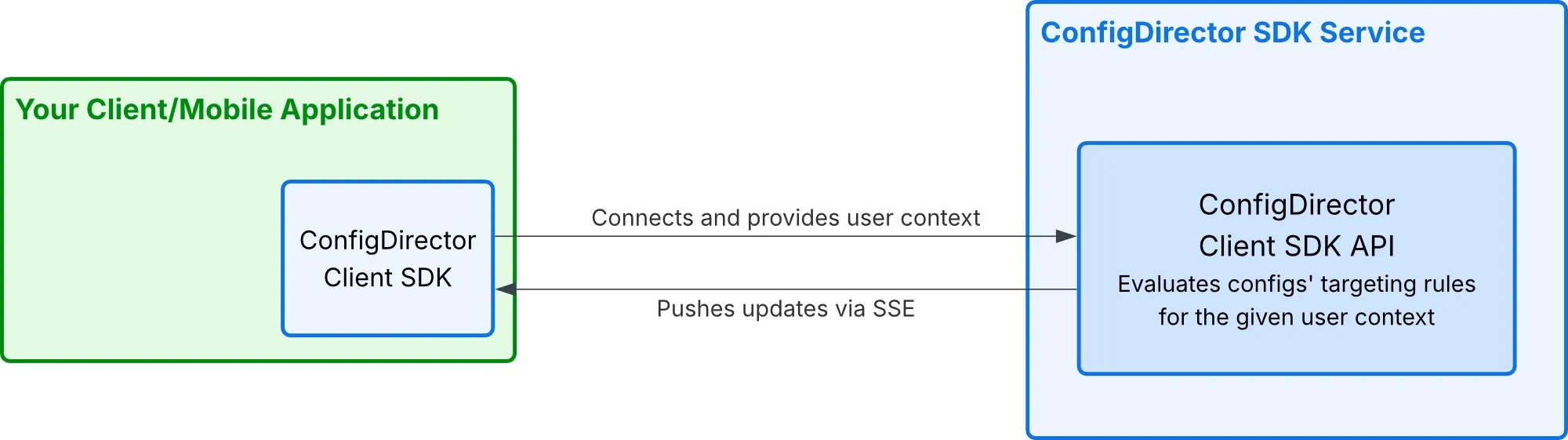
- The ConfigDirector client SDK opens a connection to the ConfigDirector SDK service. It provides the user context, if one was given.
- The ConfigDirector SDK service evaluates all of the configs' targeting rules using the user context provided, and returns the configs with their evaluated values
- The client SDK stores the payload it received from the SDK service and returns the appropriate values whenever a config value is requested by the application
- The client SDK and SDK service keep the connection open. Whenever configs or segments are updated (via the dashboard or Admin API) the SDK service pushes events to the client SDK with the updated config values.
If the application updates the user context via the client SDK, the process restarts from step (1) above. A new connection is initiated with the updated user context.
Architecture of server SDKs
Your server application makes use of on of ConfigDirector's server SDKs to communicate with ConfigDirector's services. In the case of server SDKs, evaluation is done by the SDK rather than the remote service.
The high level view is as follows:
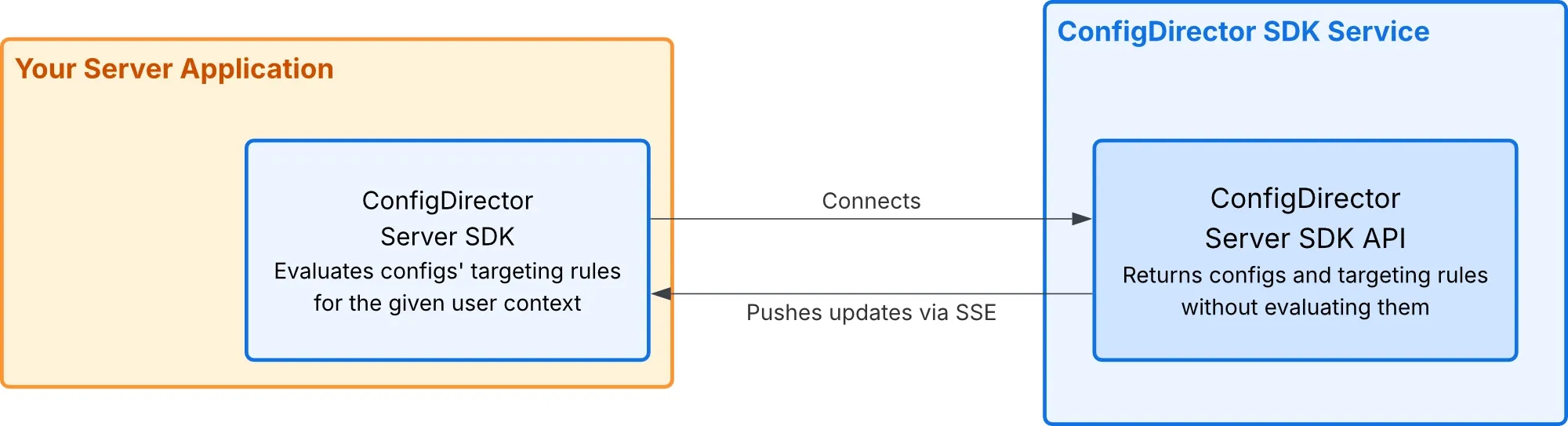
- The ConfigDirector server SDK opens a connection to the ConfigDirector SDK service
- The SDK service returns all the configs, their targeting rules, and the segments those rules use, without evaluating them
- The server SDK stores the payload in memory
- When your application requests a config to be evaluated for a given user context, the server SDK uses the in memory config definitions and targeting rules to evaluate the given config value
- The server SDK and the SDK service keep the connection open. Whenever configs or segments are updated (via the dashboard or Admin API) the SDK service pushes events with the updated configs, targeting rules, and segments.